
Copyright © 2025, Molsoft LLC
Jun 30 2025
| Prev | ICM Language Reference Sequence, searches and alignments | Next |
[ Search prosite | Binding site analysis | Pdb sequence generation | Pdb merge | Search pdb headers ]
How to search all Prosite patterns in your sequence |
Use macro searchSeqProsite. For example:
  read pdb "2dhf"
  make sequence a_1.1        # sequence of a PDB structure
  show sequence
  find prosite 2dhf_a        # 2dhf_a is the sequence of the protein
See also find prosite, find pattern and read prosite.
How to identify binding pockets |
There are three algorithms (A, B, and C) with ICM which can identify pockets:
| option | target | macro |
|---|---|---|
| A | closed pockets | `icmCavityFinder |
| B | almost closed pockets | --{make map potential} , etc., see below |
| C | pockets with good ligand-binding potential | `icmPocketFinder |
Example:
read pdb "1a28" delete a_!1,2 convert delete a_2 icmPocketFinder a_ 3. yes no |
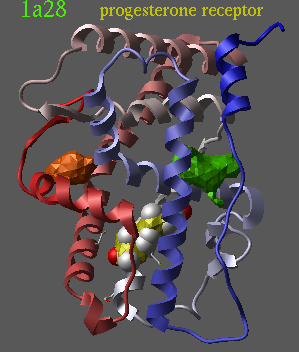
|
In the following example we find an almost closed pocket which can not be identified with icmCavityFinder .
 read pdb "1fm6"  # read the 'a' chain of RXR
 delete a_!1,9    # keep the RXR and its ligand only
 make map potential a_1 Box( a_ 1. ) 1.  # grid size 1.5 A
 make grob m_atoms exact 0.1 solid
 split g_atoms
 cool a_
 display g_atoms2 reverse
If you have problems with identifying pockets, change the grid size, the threshold level for make grop m_atoms , or try to convert object to the ICM type (the conversion will add hydrogens and make the object more dense).
How to generate a non-redundant list of PDB sequences |
The following script is a skeleton of the provided script _mkUniqPdbSeqs which is somewhat more automated.
 l_commands=no
 errorAction="none"        # if something goes wrong do not
                           # interrupt the loop
 s_pdbDir = "/data/pdb/"   # make sure you have correct path
 pdbDirStyle = 4           #
 read sarray s_pdbDir+"/derived_data/index/source.idx"
                          # you need a list of all pdb-entries
                          # (4 char. code per line will do)
 source = Tolower(Trim(Field(source,1)))
 n=Nof(source)
 for i=5,n
   read pdb sequence resolution source[i]
        # append resolution to the chain name (like 9lyz_a19)
 endfor
 group sequence "*" uniqSeqs unique 0.1 delete
        # cutoff inter-sequence
        # distance 0.1 (dissimilar by more than 10%)
#
# Other possibilities
#
#  group sequence uniqSeqs unique 5     # if two seqs differ by more
#                                       # than 5 mutations
#  group sequence uniqSeqs unique       # throw away only identical
#                                       # sequences
#

 write sequence s_inxDir + "/pdb1.seq"
                               # actual sequences for searches
 write Name(uniqSeqs) "chainList"
                               # list of protein chains if you need it
 quit
How to merge several pdb files |
The simplest way to merge two pdb files is to read them as separate objects and the use the move a_1. a_2. command. Example:
 read pdb "1crn"
 read pdb "1d48"
 move a_2. a_1.        # merges objects
 write pdb a_1. "both" # saves both files in pdb format
 write object a_1.     # saves merged object in compact binary form
Before or after merging, the objects can also be edited, translated to a new position, rename chains, change residue numbers etc. Example:
 read pdb "1d48"
 delete a_w*
 delete a_2       # delete the second chain
 read pdb "1crn"
 delete a_/33:99  # delete a C-term. part of crambin
 move a_1. a_2.   # merge the remains
 write object a_
If you want to re-engineer a polypeptide chain of a protein, using two pdb-files, e.g. to transplant one part of a protein to another and restore the bonding connectivity, you may use the modify command:
 read pdb "1crn"  # one pdb
 read pdb "1cbn"  # similar protein
 modify a_1./20:25 a_2./20:25
   # grafts a loop from 2nd object to the 1st one
 write pdb a_1. "combo"
How to search headers of the PDB entries |
There is an PDB.tab file which contains one line header descriptions of all the entries. Now you have three ways of doing it:
- In unix: grep -i kinase PDB.tab
- From ICM: you have more possibilities:
read table s_icmhome+"data/inx/PDB.tab"  # or in s_userDir+"inx/"
show PDB.head ~ "kinase"   # or
show PDB.head ~ "*kinase*" # or
show PDB.comp ~ "kinase*"  # regular expressions
# You can also
a=PDB.head~"kinase"
for i=1,Nof(a)
  nice PDB.ID
  pause
  delete a_*.
endfor
- Use the gui (Find.In PDB.By Keyword..)
| Prev Cavity analysis | Home Up | Next Molcart |