[ database | Depth cueing | distance | distance geometry | Ssbond | drestraint | drestraint type ]
column
format (multicolumn representation) is the alternative.
The database should have the following format:
FieldName1 Number|String
FieldName2 Number|String
FieldName3 Number|String

FieldName1 Number|String
FieldName2 Number|String
FieldName3 Number|String
...Example:
id   jur1
iq   24
addr  LA
addr  California

id   jur2
iq   17
addr LA
See also:
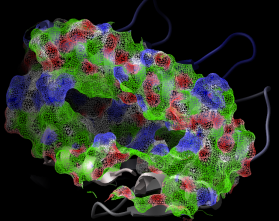
a visual effect which makes objects disappear in a fog according to the screen Z-coordinate.
Press
Ctrl-D
to invoke the effect and move the back clipping closer with MidMB to make the effect more dramatic. Also more the front clipping plane with Ctrl-MidMB to
make the front brighter.
|
|
If you use
gui adjust the front and back clipping planes using the buttons in the
graphics tool bar and vertical movements with the left-mouse-button
Two parameters influence the fog effect:
fogStartdetermines the relative Z-position at which the linear fog effect starts (the distance between the front and the back planes is 1.)color volumecolor command allows one to color fog differently from thebackground(by default they are the same).
a measure of proximity in three-dimensional or multidimensional space for
all kinds of objects, including sequences and real arrays. Sometimes it means a special
array ( parray to be exact) consisting of batches of interatomic distances. This objects
are shown in the GUI and are interactive.
See also:
Distance() function returning real distance or distances.make distanceto create distance lines and labels. It returns aparrayobject with distances.make hbondfor hydrogen bonds created in the format fo theparray"distance" object; (see alsomake 3d label)- Table(distobj distance)
is often used to calculate a set of Cartesian coordinates of a series
of objects given all (or even a subset of) the inter-object distances
(Crippen and Havel, 1988).
ICM function Disgeo() allows one to solve this sort of problems.
See also Distance().
SSBOND
records. Upon conversion of a PDB structure into the ICM-object with the
convert
command, the disulfide bonds are inherited. Important: commands
make disulfide bond
and
delete disulfide bond
are valid for ICM-type molecular objects only (and have no effect on, say,
PDB structures). Both commands change the covalent structure of the modeled
molecular object and expel/add hydrogens. In addition, SS-bonded
cys residues are renamed to cyss.
Therefore, to count the number of disulfide bonds you may simply count the cyss
residues: show Nof(a_/cyss)/2 .
Distance restraints imposed to form such a bond are defined in the file icm.cnt .
a distance restraint (sometimes abbreviated as cn ) which
imposes a penalty function on the distance between two atoms of the same object
( in contrast, tether imposes a restraint to an atom in another object ) .
Distance restraints may have different characteristics and types.
A drestraint is a basin with flat bottom between the upper and lower bounds ( Du and DL )
and quadratic walls:
| P( d ) = w*( d - Du )2 /Du | if d > Du (upper wall) |
| P( d ) = 0 | if DL < d < Du (flat bottom) |
| P( d ) = w*( d - DL )2 /DL | if d < DL (lower wall) |
drestraints are mostly used in structure determination using the NMR NOE data.
The weight, w, is the product of the weight for all distance restrains ( cnWeight )
and a specific weight for a given drestraint type.
Drestraints may be
read, written,
made, setn, shown,
and displayed.
The parameters of drestraints are written in *.cn files.
See also: icm.cnt drestraint type file description.
To activate the drestaint penalty term, use the set terms "cn" command.
The main list of types consists of general user-defined global and local types as well as a number of fixed named types used to impose disulfide bonds or peptide bonds. Drestraint types may be read, written, set, and shown.
See also: *.cn file description.