Search


ICM-Pro


Easy-to-use and complete desktop-modeling environment for a biologist or a chemist interested in molecular structure and function.

Platforms Available : Windows Vista/XP/NT/2000, Linux/i386/AMD64, SGI IRIX, Mac OS X

ICM-Pro add-ons : ICM-Homology, ICM-Chemistry, and, ICM-VLS

ICM-Pro Background

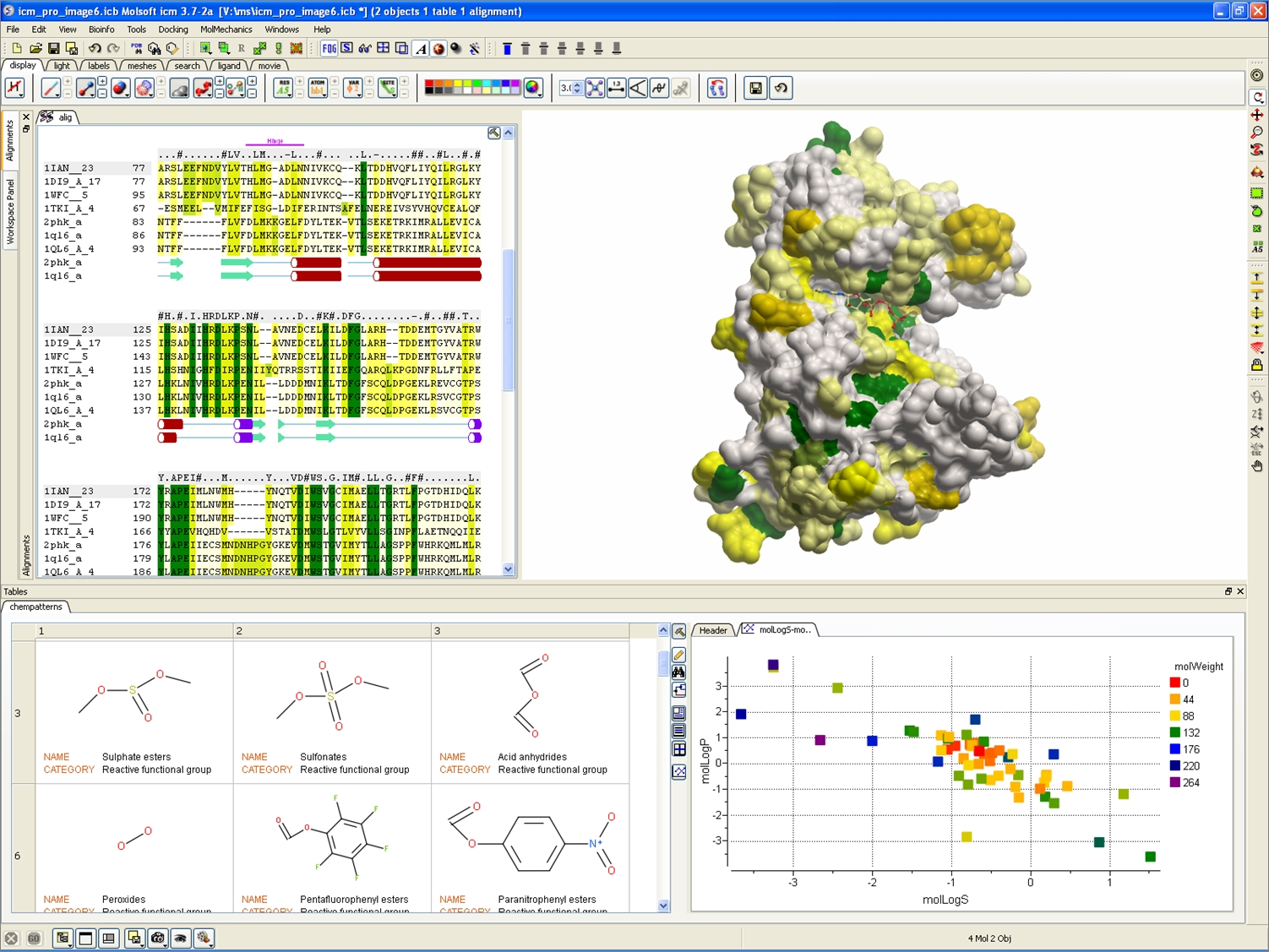
ICM empowers a biologist or chemist with lightning fast access and high quality interactive 3D views to the entire sturctural database. In just a few seconds you can browse hundreds of structures of interest load them, analyze and visualize sequences, structures, alignments, sites, study pockets and bound ligands and drugs, study surfaces, electrostatics, mutations, pockets, sequence conservations, perform docking of small molecules as well as protein-protein docking. ICM supports multiple input formats. You can search structural database by field, sequence pattern and get an interactive table for instant viewing. ICM offers a rich graphical environment and powerful views for professional quality of images and molecular animation videos.

The ICM ('Internal Coordinate Mechanics') software project was originally designed around a new molecular mechanics approach and optimization algorithm for peptide prediction, homology modeling, loop simulations, flexible macromolecular docking and refinement, and then was extended to graphics, molecular animations, chemistry, sequence analysis, database searches, mathematics, statistics and plotting. ICM-Pro contains an all atom internal coordinate force field and efficient algorithm to perform local and global energy optimization of small or large molecules with respect to an arbitrary subset of variables. In addition, ICM contains MMFF94 force field for energy optimization in Cartesian space for any organic molecule. ICM-Pro allows users to read, build, convert, refine, analyze and superimpose molecules. Includes graphics tools for diverse molecular rendering, perspective viewing, depth cueing, etc. Uses both hardware and side-by-side stereo. Allows saving and printing a screen image as a compact vectorized postscript file in addition to a compressed bitmap.

Molecular Graphics

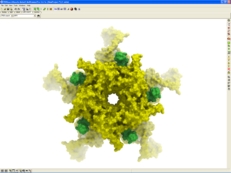
Utilize a full and robust array of graphics tools all accessible from a GUI interface. Display your molecules in wire, CPK, ball&stick, worm, ribbon, accessible surface, transparent molecular surface, perspective, depth cueing, smooth and rugged solid surfaces. Use both hardware and side-by-side stereo. Save and print a screen image as a compact vectorized postscript file (also in stereo) in addition to a compressed bitmap. Painlessly create movies featuring molecules dressed in solid representations such as CPK, smooth molecular surface, ball-and-stick read, display, reshape and write any 3D object in the Wavefront format.

Key molecular graphics features:

  • Export publication quality molecular images at high resolution and vector images (metafile)
  • Annotate, atoms, residues and sites
  • 2D and 3D user-defined labels
  • Hydrogen bond and distance labels
  • Display atom clashes, distance restrainsts, tethers
  • High quality molecular surface representation, skin, wire, xstick and ribbon representations
  • Easy control of thickness, color and type in molecular graphics. Color by atom type, residue side-chain, molecule, unique carbon atom coloring for multiple objects, bfactor, occupancy, accessibility, hydrophobicity, polarity, secondary structure, paint structure by alignment color, color by user-defined values
  • Visual effects: dynamic shadows, fog, hardware and side-by-side stereo, clipping planes, full screen
  • Export colored and annotated sequence alignments.
  • Easy to use and control animation effects: rotations, rocking, zooming
  • Store current views/viewpoints,layers and slides
  • Two kinds of stereo, including a high quality "in-window" mode, as well as a stereo mode which does not require any special hardware.

Protein Structure Analysis

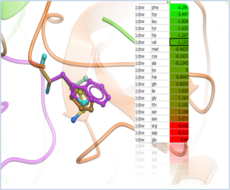
ICM-Pro provides a direct link to the PDB. Once you have downloaded a structure you can analyse the structure - flagging problem regions, superimpose multiple structures, analyse distances and electrostatic properties.

Key protein structure analysis features:

  • Dynamic link to the PDB
  • One click search and download PDB structures
  • Tabulated PDB data for easy manipulation, sorting and searching
  • Extract PDB sequence
  • PDB file preparation, detecting and fixing problems, optimization of H, His, Asn, Gln and Pro
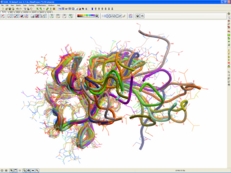
  • Superimpose multiple structures and calculate RMSD
  • Calculate contact area, surface area
  • Measure and display distances and angles
  • Fully-linked and dynamic structure-sequence environment
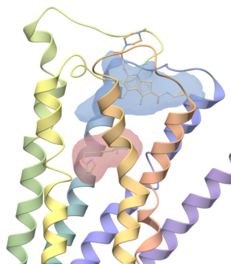
  • Drug binding pocket prediction
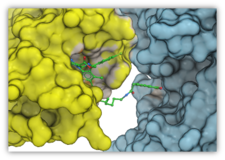
  • Protein-protein interaction prediction
  • One click ligand pocket display and h-bond optimization with ligand
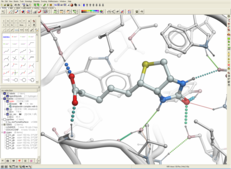
  • One click analysis of protein-ligand interactions
  • Predict protein flexibility
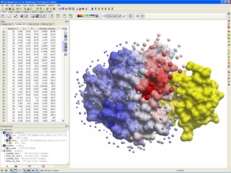
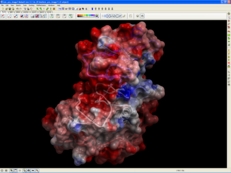
  • Build electrostatic surfaces
  • Interactive Ramachandran plots

Crystallographic Analysis Tools

The key to understanding a protein structure is to fully evaluate the underlying crystallographic information contained within a PDB file. For example it is important to understand the full biological unit of a protein to identify if crystal-crystal contacts have influenced the structure.

The crystallographic analysis features include:

  • View crystallographic cell
  • Generate crystallographic neighbors
  • Build biological units and apply transformations
  • Direct link to electron density map server
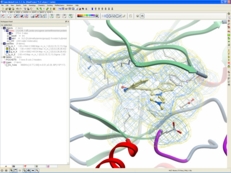
  • Contour electron density maps
  • Convert electron density map to grid energy map for real space refinement

Protein Structure Prediction

Predicting low energy conformations for chemical compounds, peptides, nucleic acids etc.: Take a peptide sequence and predict its three-dimensional structure. Of course, the success is not guaranteed, especially if the peptide is longer than about 25 residues but some preliminary tests are encouraging. Evaluate local secondary structure preferences directly from the simulation. Watch a movie with your peptide folding.

Protein Modeling: ICM-Pro has a good record in building protein modeling. There are procedures which will regularize or build the backbone, shake up the side-chains and loops by global energy optimization. You can also color the model by local reliability to identify the potentially wrong parts of the model. This does not include, however, the fast routine for building a complete model by homology with loops combined with the database search ( ICM-Homology is a separate add-on to ICM-Pro).

Loop modeling and protein design: ICM-Pro was used to design two new 7 residue loops and in both cases the designs were successful. Moreover, the predicted conformations turned out to be exactly right (accuracy of 0.5A) after the crystallographic structures of the designed proteins were determined by Rik Wierenga and his coworkers.

Key structure prediction features:

  • A variety of different energy terms and grids are available
  • Define distance restraints and tethers
  • Local minimization
  • Protein structure prediction and optimization
  • Prediction of the effect of a mutation
  • Generation of multiple receptor conformations
  • Model using restrainsts and symmetry

Bioinformatics Tools

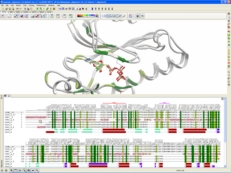
ICM-Bioinformatics is included in the ICM-Pro package allows users to search a sequence database with high-quality global pairwise and multiple alignment algorithms. Also allows pattern searches, prosite and profile searches. Multiple sequence alignments are fast, the algorithm produces evolutionary trees, principal component view, annotation transfer from sequence to structures, threading and alignment visualization tools.

Sequence Analysis: Find alternative alignments and repeats using filtered and probability based dot-plot. Make accurate pairwise sequence alignment with a double affine gap penalty and evaluate the probability that the two aligned sequences share the same structural fold. Build multiple sequence alignments, construct and plot evolutionary trees, visualize sequence clustering in two and three dimensions, predict protein secondary structure with a set of powerful algorithms. Search your sequence interactively or in batch through any database and generate a list of possible homologues that are sorted and evaluated by probability of structural significance. The sensitive and rigorous Zega alignment is used for each comparison. This search may give you more homologues that a BLAST search! The output may presented in a linked table form. The text sequence databases can be indexed and queried with ICM.

Key bioinformatics features include:

  • Read in sequence and alignments in FASTA and other formats
  • Fast sequence searching in Blast databases
  • High quality pairwise and multiple alignment generation
  • Interactive alignment editing
  • Predict sequence secondary structure content
  • Structure-linked sequence alignments and alignment annotation
  • Drag-and-drop alignment generation

Electrostatics

The Poisson equation for a molecule of any size can be efficiently solved using the boundary element algorithm that does not depend on any grid, and uses the exact analytical molecular surface as the boundary. ICM-REBEL calculates the accurate electrostatic potential of a molecule using boundary element algorithm and generates a 3D surface skin model colored by potential. Solves the Poisson equation for a molecule with exact positions of electric charges. This method is fast (takes seconds for a protein) and accurate. The energy calculated consists of the intramolecular energy and the solvation energy, which can be analyzed separately. Evaluates intermolecular solvation electrostatic interaction energy.

Chemistry

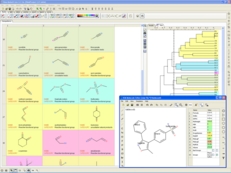
Chemicals can be sketched and saved in the ICM Molecular Editor or viewed in a chemical spreadsheet. More chemistry tools are available in ICM-Chemistry.

  • mol, mol2, smiles, and sdf formats supported
  • sketch chemical compounds in the ICM molecular editor
  • chemical property monitor - flags bad groups and properties
  • chemical templates for easy drawing
  • generate chemical images
  • generate, display and manipulate chemical spreadsheets
  • 3D compound browsing in graphical display
  • browse and lock structures in graphical display
  • highlight substructure and properties

Small Molecule Docking

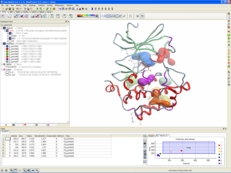
ICM-Docking provides a unique set of tools for the modeling of protein/ligand interactions. Performs fast and accurate docking of fully continuously flexible small molecule ligands to a protein represented by grid interaction potentials. Allows users to dock the ligand to the explicit full-atom representation of the receptor with arbitrarily selected subset of flexible side-chains. Performs docking by the ICM stochastic global optimization procedure which combines pseudo-Brownian positional and torsional steps with fast local gradient minimization. Uses continuously differentiable grid potentials to ensure rapid convergence of local minimizations. Contains a sophisticated algorithm for tracking the simulation trajectory to avoid trapping in sub-optimal conformations and allows efficient search of the conformational space. Provides tools for automatic conversion of 2D chemical structures to 3D, sophisticated atom type assignment, charge assignment and recognition of rotatable bonds. Allows parts of the ligand to be automatically constrained to a pre-defined position during docking. Generates multiple conformations of the free or docked ligand. Special Monte-Carlo steps allow sampling of stereo isomers for racemic compounds. Analyzes protein surface for potential binding pockets and displays the interaction properties on the 'skin' representation of the surface. Uses graphical user interface for easy set up of the simulations. Provides maximum flexibility to user by allowing the docking scripts, which are written in intuitive ICM molecular modeling scripting language, to be modified to best meet specific project requirements. Performs protein-protein docking with fast global rigid-body search with grid potentials. Refines best docked configurations with flexible side chains to allow for the induced fit.

Small molecule docking features include:

  • Drug pocket identification, analysis and visualization tools
  • Small molecule docking
  • Sample racemic centers and double bond cis/trans
  • Relax covalent geometry
  • Keep carboxyls neutral and set charges for amino groups
  • Template docking
  • Incorporation of flexibility into the ligand and receptor side chains/backbone
  • Multiple-receptor conformation docking
  • Automated model building into density - docking to electron density
  • Tabulated and easy to visualize docking results
  • Multiple solutions ranked by energy values

Protein-Protein Docking

The ICM-Protein-Protein docking procedues has continually lead the pack in docking accuracy in the worldwide CAPRI protein- protein docking competition. In the past ICM has been used to dock ab initio a full-atom model of lysozyme to an antibody with 1.6A accuracy (Nature Struc.Biol., 1994, 1,259). Later, Maxim Totrov and Ruben Abagyan correctly predicted the association of beta-lactamase and its protein inhibitor in the Docking Challenge (Nature Struc.Biol., 1996,3,290) using the ICM pseudo-Brownian docking with subsequent ICM side-chain refinement.

References

ICM Methods

Abagyan, R.A., Totrov, M.M., and Kuznetsov, D.A. (1994) ICM: A New Method For Protein Modeling and Design: Applications To Docking and Structure Prediction From The Distorted Native Conformation J. Comp. Chem. 15, 488-506. A description of the original ICM method.

Abagyan, R.A. and Totrov, M.M. (1994) Biased Probability Monte Carlo Conformational Searches and Electrostatic Calculations For Peptides and Proteins J. Mol. Biol. 235, 983-1002. Description of the ICM highly efficient global optimization procedure.

Abagyan, R.A. and Totrov, M.M. (2001) Rapid boundary element solvation electrostatics calculations in folding simulations: successful folding of a 23-residue peptide. Biopolymers. 60(2):124-33 Description of the electrostatics REBEL method

Drug Binding Pocket Identification

An J, Totrov M, Abagyan R. (2005) Pocketome via comprehensive identification and classification of ligand binding envelopes. Mol Cell Proteomics. 2005 Jun;4(6):752-61. A new fully-validated algorithm for the prediction of ligand binding sites with high accuracy.

Fernandez-Recio, J., Totrov, M., Skorodumov, C., Abagyan, R. (2005) Optimal Docking Area: A New Method for Predicting Protein-Protein Interaction Sites. Proteins 57:400-13. A state-of-the-art method for the prediction of protein-protein interaction sites.

Protein-Protein Docking

Fernandez-Recio, J., Totrov, M., and Abagyan, R. ICM-DISCO (2003) Docking by Global Energy Optimization with Fully Flexible Side-Chains Proteins 52:113-117. The ICM Protein-Protein docking method, which ranked highly in the worldwide CAPRI docking competition. See the two papers below by Mendez et al. for evaluation of results.

Mendez R, Leplae R, Lensink MF, Wodak SJ. (2005) Assessment of CAPRI predictions in rounds 3-5 shows progress in docking procedures. Proteins. 2005 Aug 1;60(2):150-69.

Mendez R, Leplae R, De Maria L, Wodak SJ. (2003) Assessment of blind predictions of protein-protein interactions: current status of docking methods. Proteins. 2003 Jul 1;52(1):51-67.

Copyright © 2005 Molsoft LLC.
All rights reserved.
Legal Notices