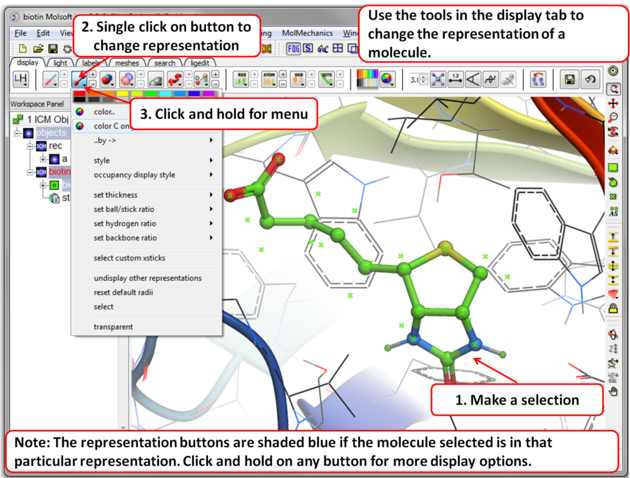
To change the representation of the protein, make a selection and then use the tools in the display tab.
There are 6 main types of representation:
- Wire: Wires connecting covalently bound atoms of a molecule. This representation has no defined thickness as such will not make shadows. Useful for showing the chemical structure of a small molecule.
- Xstick: Covalent bonds are represented as cylinders whilst atoms are represented as small spheres.
- CPK: Atoms are represented as spheres with their respective van der Waals radius and coloured according to a standard defined by Corey, Pauling and Kultun.
- Surface: Solvent accessible surface. This is the center of water sphere as a water probe rolls over the molecule.
- Skin: A Connolly molecular surface over the selection. This is a smooth envelope touching the van der Waals surface of atoms as a water probe rolls over the molecule.
- Ribbons: Cartoon representation of protein and DNA secondary structure. Protein residues marked as alpha-helices ('H') are shown as a flat, helical ribbon, those marked as beta-sheets ('E') are shown as a flat ribbon with an arrow-head, and the rest are shown as a cylindrical "worm". If secondary elements are not defined everything will be shown as a cylindrical worm. ICM can automatically assign secondary structure: Tools/3D predict /Assign Helices and Strands